Saturday, 25 May 2013

Interaction Design

I would like to think that I've been fortunate enough to have been born at a time when video games and all other technology have become major parts of individuals lives. Some people may not agree, but as well as providing people with enjoyment and entertainment there is no doubt in my mind that technology provides so much more. It can save lives and make life so much easier for anybody and everybody.

Today, one of the first things to consider with the development of new technology, (although sometimes you wouldn't think so, *cough, Windows 8 *cough), is how a person will interact with it. Companies now spend millions in development of interaction with their technology whether it be software based in user interfaces and AI or hardware base in the peripherals we use such as controllers, cameras a keyboard or the remote control for your television.

In recent years video games in particular have had huge developments in interactive design, particularly home video game consoles. I’m a Playstation gamer and have owned my PS3 from day numero uno and it has delivered me many new interactive experiences, some of which were complete surprises. The first 'device' in order to interact with the Playstation as many of you I’m sure will be aware is the controller or 'game-pad'. The game-pad is what the user will hold in their hands in order to control a device. Over the last 20 years or more, Sony have spent millions, if not billions in the design of their controller, the most recent being the 'Dualshock 3', as do many other companies. Companies will strive to deliver the most 'ergonomically' designed controller possible to make it as comfortable to hold for long durations, yet it is impossible to please everyone and designs change drastically from device to device. But as mentioned, since owning the Playstation3 I've also been treated to a few surprises in terms of interaction with the video games I've played. With the PS3 also came the introduction of the new Playstation Eye camera which tracks players movement with no need for a controller at all. A game called Operation Creature Feature is a particularly memorable game. The game presents you with one whole level on the screen where a number of strange looking creatures reside in one corner and their final destination awaits them on the other, very similar to Lemmings, but the levels are much more artistically advanced to say the least. By only using your hand, which the Playstation Eye tracks, you have to pick the creatures up and guide them through the obstacles each level presents without dropping them and thereby killing them.

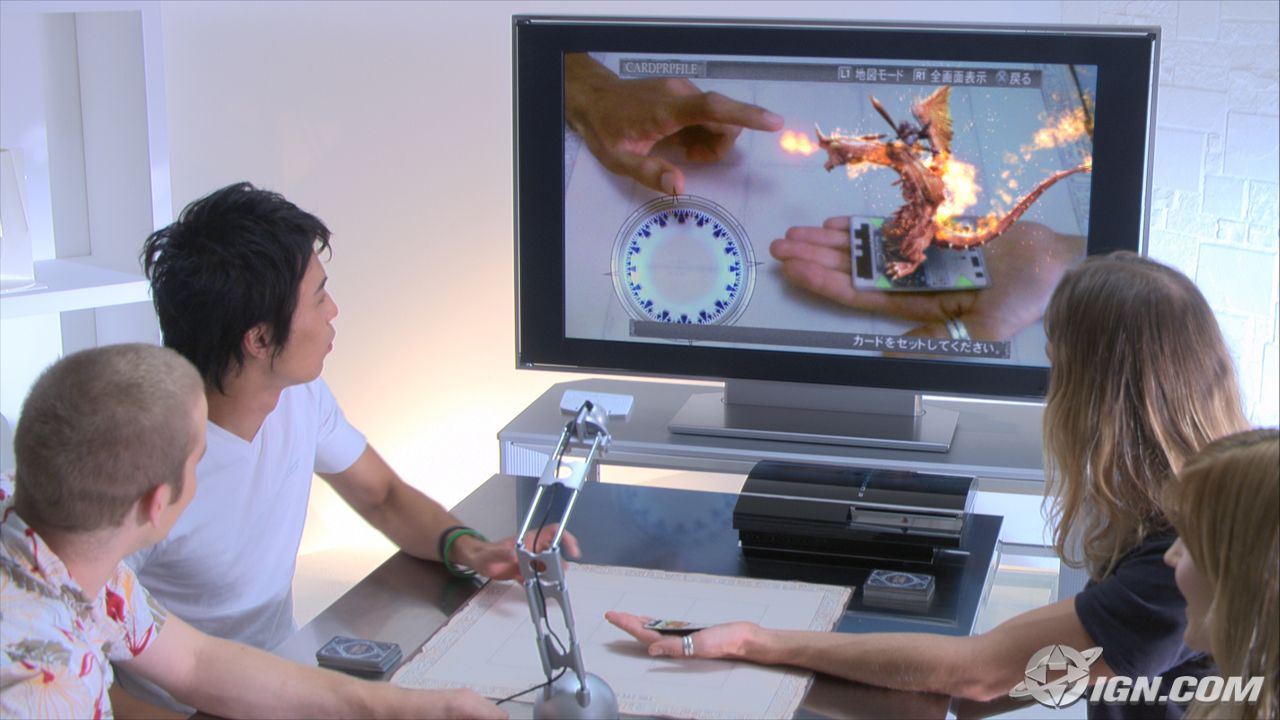
Just after the PS3 Playstation Eye had been released, I also bought a game called The Eye Of Judgement. I'm a geek so bear with me here. The game is actually a card based game similar to Pokemon or Magic the Gathering, but with an extremely impressive twist. The game is packaged with a game mat, a square divided 3x3 into nine equally sized boxes and a small stand for the camera so that it looks directly onto the play mat. When a card is placed onto the mat, the camera reads them, and all of a sudden a creature or monster jumps out of the card on the screen as if actually in the room with you! Once two cards are placed onto the mat the game will cut to a scene where the two creatures will fight each other! This will only happen if the cards are facing each other though, as the camera will even read which way the card is facing and the creatures will also face in that direction, so another element of strategy is added to the game-play. What is perhaps even more impressive is that if you hold a card in your hand underneath the camera the creature will still jump out of the card on screen, and you can then turn your hand to turn the creature around and view it in a full three-dimensional space.

More recently the Playstation Move was introduced as another peripheral device for interacting with the games console. Unfortunately it has received very mixed and at times negative reviews. It is a very similar device to the controllers for the Nintendo Wii, but is claimed to be much more accurate. You hold the Move controllers in one hand, similar to a stick, and can play similar games to the Wii such as sports games like tennis, but the controller has another ace up its sleeve, or on the end of it if we're going to be literal. The controller has a small ball on the end of it which glows, different colours for different players, which, when used in conjunction with the Playstation Eye camera, is used for extremely accurate motion tracking. Games such as EyePet, fully utilise both the Playstation Eye and Playstation Move controller. The game gets the player to, ideally, sit on the floor in front of the television with the camera set to face the player and an area of the floor. When the player taps the floor, a small cute, monkey/ dog hybrid creature jumps out of the floor and the player can interact with the creature in many different ways. The game, probably since a Tamagotchi, is the first true virtual pet experience and the player must wait for their creature to hatch from an egg and then continue to care for it, by feeding it (with Playstation buttons), playing with it, (draw a picture on a piece of paper and hold it up to the screen and the pet will copy your picture and then turn it into a real object on screen!), as well as wash it and dry it. The real interaction is when the player does come to do any of the above things though, when drying the creature for example, using a Playstation Move controller, the camera will replace the controller in your hands (on screen), with a hair dryer! The technology is quite amazing, by rotating the controller and turning it, there is no way of telling on the screen that you're holding anything other than a hair-dryer and at first it is utterly mind blowing!

My most recent experience with new interactive technology, which I was saving for a separate blog but is probably better placed here, is 3D. Again, it has received mixed reviews, and again, many negative, but most people have only experienced 3D films, and most people have only experienced them at the cinema. Me and my wife recently bought ourselves a new Samsung 3D smart TV and watching a 3D blu-ray on the Playstation, with the active shutter 3D glasses that the television uses, the films are truly awe inspiring. Avatar, The Amazing Spider Man, The Rise of the Guardians, Brave and more are just beautifully presented in 3D. Even I was extremely cautious about 3D initially, and I'm usually the first to get suckered in to a new technology, but five minutes of watching a 3D movie on a true active shutter television, on a true 3D blu-ray disc and I assure you, you will converted.


Because the Playstation 3 uses blu-ray discs though, it is the first ever games console to fully present 3D specific games, which have been developed specifically to fully utilise the 3D technology. Gran Turismo 5 in 1080p, 60fps and 3D! Now that is a recipe to truly blow anybody away, the experience is just unbelievable and the depth it adds to the viewing experience is just indescribable, you truly have to see it to believe it! But the most recent game I had the pleasure of playing right through in 3D, was Uncharted 3 Drake's Deception. At a point where I didn't think games could get any more immersive, technology once again swoops in and proves me wrong. The 3D environments are so detailed and impressive, and enemies laser sights come right of the TV and I found myself ducking out the way! It has been one of, if not the most impressive, interactive gaming experiences I've ever had, and I honestly cant put into words how it looks and how it feels when playing, so I implore you to pick up a PS3 and a 3D-TV, or find a friend who has one and try it out, it is an amazing interactive experience!

What will technology bring us next? I cant wait! 

Operation Creature Feature - PS3

Eye of Judgement -PS3

Eye of Judgement -PS3

Eye Pet -PS3

Eye Pet -PS3

Uncharted 3 Drake's Fortune, 3D - PS3

Second Year Personal Review


For me, my second year could only be described as a roller-coaster ride from start to finish. I am writing this blog completely openly so that anyone who wishes to read it may do so. I hope this final second year blog will enable you to gain a little insight into my successes this year and my personal struggles I have endured in order to reach my goals.

My story of recent years is that in January 2010 my girlfriend suffered a blood clot on her brain and at that time myself, family and friends were told to fear for the worse. Both I and my girlfriend, Sophia, at that time were first year students on the DMU Game Art and Design course until, after only four months in, it all came to an abrupt halt. The force of what happened on January 11th 2010 to Sophia impacted so many people and it will probably never leave me completely. But, as time ticked away, an eternity for me, Sophia began to show signs of improvement and her sheer determination brought her to a point where she is now able to live a fairly normal life.

In September 2011 Sophia had reached a mile stone in her long hard road to recovery and I had built enough courage, as well as enough encouragement from certain individuals to make the impossible decision to rejoin the Game Art course without her. I have worked and studied hard all of my life and so has Sophia, and we deserve the chance to work for a degree, even if it means we will only be rewarded with one degree between us.

My first year back on the course was more difficult emotionally than anything else, but I was greeted by many new faces with understanding and support which lifted me up and carried me through. This year started so positively, Sophia had started a college course for people who had suffered brain injuries and it gave me strength to know that she was still able to enjoy an education in the arts. The work for myself at uni was intense and plentiful and with so many things to keep on top of at home away from my studies, paperwork, various appointments for Sophia, paperwork, contact with social care, doctors, deputies, carers and more, and more paperwork etc. everything together began to get on top of me and my anxieties grew as I became more and more aware that having so many balls up in the air, it was inevitable that I was eventually going to drop one.

I do not enjoy living in Leicester full stop. For the most part, people are rude, ignorant and have no compassion for their fellow human beings, in 2011 I was mugged at a park at the end of my street, and when Sophia became ill I was put through three years of real hell and suffering and my life was ripped apart, over before it had barely began. But as my life began to fall back into place, my worries, anxieties and the stress brought on by everything didn't seem to be dissipating.

For reasons I am unable to explain this year I have worried and become stressed more than ever before. At times I let things get to me too easily, even trivial, unimportant things, but I am passionate about certain things and this year the prospect of staying here in Leicester a minute longer has just gotten too much and I have come so close to packing up, dropping my studies and leaving and never looking back, the pressure and the stress has made me ill and it eventually came to a point where it was obvious to me that none of this, a degree, my friends in Leicester, and the small life we have built for ourselves here was worth it. It was time to go.

Up to this point I had still worked as hard as I always do on my university work and was more than happy with the quality of the work I had been producing, but nothing was going to stop me from producing this work anywhere and at any time. What happened next was what every person deserves when they reach a breaking point and what I hope everyone is offered. The support from my friends, my family, my acquaintances, my tutors and my friends and fellow students at university burst into life and overwhelmed me. The decision was still my own, but by the strength of others it was being forced back, fought back in the opposite direction. The right direction?

I don’t believe in fate or destiny, or that everything that happens, happens for a reason. Post Hoc Ergo Propter Hoc. I am a scientist at heart and a geek in the flesh, and what I KNOW is that at present, the only real logical explanation that anything happens when it happens, IS BECAUSE IT JUST HAPPENED. You might say that sheer luck or the infinite possibilities of the way the universe works happened to give me my final push, others are entitled to say that I was meant to stumble across what I did. All I know is that at the final fork in the road I was presented with a random quote from Thomas Alva Edison;

“MANY OF LIFE'S FAILURES ARE PEOPLE WHO DID NOT REALISE HOW CLOSE THEY WERE TO SUCCESS WHEN THEY GAVE UP”.

With the second year group project looming my decision to stick at it and persevere would turn out to be the right one, and a boost in energy, positivity and willingness was exactly what I needed in order to manage the incoming influx of work for the project. Fortunately though, in February, I was pleasantly surprised to be informed that I was being placed into a group with whom I already knew were five other incredibly hard working and talented students who, over the next fourteen weeks would only reinforce my already high opinion of them. Not to say that I'm not also confident that during the project I worked impeccably hard to make an outstanding contribution to the groups work, the work was difficult enough, but with the added pressure of my caring role at home it has taken every last ounce of my energy to produce the amount of work at the standard that I have. But the support and understanding given to me from my five team mates during the project, Chelsea Lindsay, Luc Fontenoy, Dominic Bell, Daniel Peacock and Dan Hargreaves, made everything so much easier and so worthwhile. They are truly wonderful individuals and extremely talented artists. I wish them all of the luck in the world in their future endeavours and here is to hoping that we may have the opportunity to work together again in the future. Again I would like to say that I have been extremely lucky to have been placed in this group with five other hard working and talented artists.

Before I finish my post, I would just like to wish the best of luck to two of my fellow students and close friends who have been given the opportunity to work with BMW in Munich, Germany for a whole year starting in September. I am insanely jealous of you both but I'm certain that you will both be fantastic role models for the Game Art and Design course and go on to have very successful careers within the video game, art, visual effects industries or wherever else life leads you.

This year has been one of, if not the hardest years of education I have ever endured, for all of the reasons above and many, many more. I would like to end my post by taking the opportunity to thank my beautiful wife Sophia, and my wonderful family for the support and understanding they have offered me during the whole year. I have had to lock myself away from the world for many, many hours over the last eight months in order to fully devote myself to the work and Sophia, family and friends have been wonderful in offering constant support and patience at times when I have become upset and stressed with the amount of work I have had to do. So I thank you all, and give my word that what ever next year brings, whatever next year throws at me, I will give as much effort and devotion to my work as I have this year and finally come home with that scroll of paper that me and Sophia more than deserve.


Thursday, 9 May 2013

The Group Project, Finished, Part One

After fourteen weeks of impeccably hard work, yesterday myself and the rest of my group, (Chelsea Lindsay, Daniel Peacock, Dominic Bell, Luc Fontenoy and Daniel Hargreaves, Pudding Lane Productions) gave our final presentation to our tutors and the rest of our year group as well as a number of final year students. We all felt the pressure, we all felt the nerves, but we all felt confident, as we have throughout the project, confidence in how much effort we had put in, confidence in the quality of our work and confidence in the outcome of our project.

So I hold my hands up and take full responsibility for the fact I haven’t updated my blog for a while in regards to the work I have been doing for the group project, and I apologize for that. But, I can assure you full well that the work has been done, in fact, apart from a little visual design work, the group project work is the only work I have been doing since my last update 11 weeks ago. I didn't even take any time off over the three week Easter break last month like some of the other members!

Its all been worth it though, our project has just gone from strength to strength and all thanks to the hard work every member of the group has put in as well as the fact that the team has gotten on so well from day one. We have helped each other, supported each other and I'm so happy that I was put in a group with such talented artists.

So lets get on to the work I have contributed to the project since my last update! I wont go into to much detail on my processes of development as it would no doubt make this blog very, very long but I will try my best to give a little description of what the work was for. More information on all of the teams work can be found at our group blog;
http://puddinglanedmuga.blogspot.co.uk/
I will also go into much further detail on all of my processes in my personal design document.

  • Week Three - In week three myself and two other members of the group took a trip to Rutland and Oakham to begin gathering some first hand reference for our modular buildings, more information can be found on that trip at our group blog here;
http://puddinglanedmuga.blogspot.co.uk/2013/02/visit-to-rutland-and-oakham.html
With a little time left at the end of the week I began to experiment with the building process of modular buildings;
Team photo of the Rutland trip
My first try at modular buildings
  • Week Four - In week four the team began to split the work up between the members. The ideas were flowing and the diversity of work needing to be carried out was growing. After the Rutland trip I'd managed to get plenty of reference images of churches and church ground objects, and from my initial research and concepts I had included some churches in those too with gravestones and a church wall. The rest of the team liked those concepts and the idea of including church grounds in our level so this week I was taken away from my modular buildings and asked to build a decent selection of low poly gravestones. Seen as other members of the group were developing their modulars, the team thought it would be a good idea for me to do the gravestones as well as a modular church wall so that we could start to demonstrate how the level would also be populated with smaller assets.
http://puddinglanedmuga.blogspot.co.uk/2013/03/week-5-modelling-under-way.html


  • Week Five - At the end of week four I spent some time completing the minibus test at the university and was able to arrange a trip to York, The Shambles, for all of the teams taking part in the 'Off The Map' project using the university minibus. It was a great opportunity for the team to collect more first hand reference, and because I was driving the minibus we were able to spend as long as we liked in York and all of the team members were able to attend. The trip was fantastic and gave the whole team a real sense of just how tightly packed the 17th Century London Streets would have been. More information on the York trip can be read at our team blog here;


The Shambles in York
After the trip the team went into week five in full swing, full of inspiration and ideas from the York trip. For the week I was tasked with producing a selection of street specific concepts for Pudding Lane. The team were worried that, although the level was beginning to grow rapidly, a lot of the streets were beginning to look very similar. Some of the team members were doing more detailed concepts of their designated streets, looking at various props that might populate certain streets. I on the other hand decided to look into the teams idea of colour grading individual streets to bring variety to the level. I have to admit, I’m not the greatest fan of digi painting as it is, wont go into that now, so I decided to produce a variety of water colours as I'm confident with the medium and I think the medium lends itself well to portraying the atmosphere the team hoped to convey in the level.
Week Five team blog;
The watercolours I produced are shown below;


  • Week Six - Before the team had their first meeting of the week I first spent a few hours in and around Leicester city centre gathering more reference for the team. Some reference particularly for use for modelling as some for textures in the coming weeks. I also wrote an independent blog on the teams blogger on my adventures around Leicester which can be read here;


After collecting all of the reference in Leicester, my job for week six was to produce a selection of textures for the project. The team hoped to get the full selection of 'modular' type textures done for all of the buildings this week so we planned all of the textures we thought we needed, discussed the amount of material id's our modular buildings should use, and then the textures were divided between myself and two other members of the team. The team was also hoping to bake the textures from high poly models in order to ensure the textures were of as high a quality as possible. I was a little unsure about this as I haven’t one much modelling in ZBrush and therefore wasn't very confident with it but one of the major benefits of this project has been the fact that certain team members are strong in certain areas of their work and, especially because our team got on so well, we were all able to share our knowledge in these areas in order to help others. Dan Hargreaves is much more familiar with ZBrush and high-to-low poly baking in general and was able to help me a great deal with the whole process, providing me with plenty of advice as well as links to good tutorials on the process. In the end, I decided the best way I could go around doing my textures was to do the main details for the stone work and bricks by first baking the larger stone shapes and the using the program nDo2 to create the smaller details. For my wood and plaster textures I purely used ZBrush to sculpt these. Another thing I found hard was creating a tileable texture within ZBrush, but again Dan was able to help me with that process and any other seams for these I was able to fix in Photoshop. I was extremely happy with the outcome of the textures I produced after not being so confident with the process at the beginning of the week.
Team's week six blog;


  • Week Seven - Week seven got off to a slow start as it was also the start of the three week Easter break, but prior to the holiday the whole team had a lengthy meeting to discuss the jobs we would all like each other to do over the break, and anything else that might of needed to be done we could all chat on Facebook. I had decided to stay in Leicester anyway over the break instead of travelling home to the parents as I was planning to basically not take a break and work throughout the holiday. So, for week seven, to start the Easter break, I was tasked with completing my set of modular buildings, I hadn't finished these with doing the modular church assets in the third week of the project so it was time for me to finish mine. I set myself the task of completing ten modular buildings for the week, concentration of keeping the main structures the same, two/ three stories, and creating as much variety as possible in building shape, wooden beam distribution, door position and shape, window positions, size and shape, chimney position, size and shape not forgetting that the textures completed last week would also add even more variety to my buildings.

Below are my modular buildings as well as the team blog for week seven;

Sound In Video Games


I cant think of any way a person could go through life without being affected or influenced by music, music can define lifestyle, culture and personality no matter how small or large a part it plays and there is no doubt that music has played a large part in history. Music has an undeniable power to evoke emotions and it affects how we perceive things. Just like art, music can be powerful, controversial and influential.

All that being said, I cant really stress enough how important music is in every walk of life. Within the world of media, music has always been a big part of the film and television industries with films like Star Wars, Indiana Jones, and even older films like The Good, The Bad and The Ugly having their own defining original scores, its only really in recent generations that we have seen the sounds of video games matching the audio quality of such films with their symphonic orchestral scores.

Gone are the days of the beep, bop, boop of Pac-Man and Pong, as technology develops, faster processors, larger storage devices, so too has the audio quality of games. When the PS3 was released I had worked hard at my part time job to save up and buy myself a HD-TV and I used to go mad at my friends who would play theirs on old CRT televisions. As the technology has progressed within the consoles themselves so to has the technology within the peripheral devices needed to play the games and get the 'full' experience. You see, I'd also bought myself a cheap-ish surround sound set, and what a difference it made! So much so, I've not used the standard sound from my TV set for at least seven years! Once you get used to it and then switch back to the standard television speakers the difference is just unbelievable! And for me, that is what the sound, the music does, it makes the difference, it makes the experience what it should be, it evokes the emotions, the feelings, it delivers the final impact a game deserves.

Today, visuals are only half of the story, as sound in video games becomes more and more crucial, good sound design grounds a player in the environment, transports the player to the fabricated game world and importantly, lets the player know what’s going on around them. As you may be aware from previous blog posts, I'm very into my motor sport and a sucker for racing games, I love playing Gran Turismo with the surround sound. The sub-woofer can deliver the deep down growl of a v6 engine and the surrounding speakers makes it feel as though the other cars are really around me, close behind me or close on the inside going into a corner. Every other genre of game is only enriched by its sound though, the clinking and clanking of a Necramorph waiting around the corner in Dead Space builds the suspense and the tension, the ear piecing shrieks of gun fire surrounding you in a war game. And as the technology becomes more readily available and affordable, just as high definition television sets have over recent years, the demand in the market begins to rise and pushes things forwards. Although, as with HD when it was first released, it is hard to introduce people and get them on board, especially with sound. Seeing a leap in visual quality, in graphics, is easier, its much harder to convey the experience of a high-end surround sound set up, but as developers continue to strive for new and innovative ways of introducing the consumer to great sound quality, the sophistication of sound design should continue to grow with the demand.

The wonderful thing about the type of media a video game is, is that each component is there to compliment the other and the final product could simply not work without all of the cogs running smoothly in unison. So for me, sound in a video game is just as important as the visuals or anything else, whether it be an epic score, a catchy theme tune or the endless sound effects needing to be implemented in today’s games, the effect of being immersed within the games environment is probably the most important thing I desire from a game, and this could not be done without sound.

Monday, 11 March 2013

The Group Project; Week Two

Pudding Lane Productions Group Photo on the British Library visit

In week two the groups, including ours, had the opportunity to visit the British Library for the day. During the visit we were given a fantastic tour of the building learning about the history of the building and how it operates today in a modern society. One of the things I was most fascinated by was the Kings Library tower at the heart of the library. Immediately upon entering the building the tall glass tower which houses books collected by King George III made a huge impression on me and during the tour I had plenty of questions to ask and was fascinated by the pure volume of books kept within the tower, the age of the material and the potentially infinite value of what I found in front of me.

Our group were then given the pleasure to be led to the 'Map Room' within the library to look at originals of the digital copies of various historical maps courtesy of Stella Wisdom (British Library) and Tom Harper (Curator of Antiquarian Mapping). It was a fantastic opportunity to be able to see a selection of maps and other reference material first hand and right up close. The whole group spent a good length of time pouring over the maps and it was a great opportunity to discuss more ideas of what we would all like to achieve from the project. The group/ team were coming up with lots of new inspiring ideas and it was awesome to be able to demonstrate these ideas using the actual maps in front of us.

As we discussed I noticed that one of the larger maps in the room was actually of a much later date than we were hoping to recreate in the project but the smaller map at the corner of the table which was London after the Great Fire by John Leake, 1667 which seemed like the closest we were going to to get to the date of the time we were hoping to construct which we agreed was going to be 'the latest point in time before the great fire'. This was decided as we all wanted to accurately recreate the London streets of the time with no effect of damage or destruction from the fire. It was agreed that this is the map we would work from throughout the project so that we could ensure that there would be a consistency throughout from the whole group.

One of the things I was mostly interested in when surveying the maps was the actual scale of things, something I would take upon myself to look into further in the next week in order to begin to give the group a real idea of things such as the width's of the individual streets to further enhance the accuracy of the project. To quote from the group blog, during our discussions at the British Library, we had gathered some general ideas about what we wanted to create for the project; a gloomy, depressed City of London at the latest point before the Great Fire started, ridden with plague and filth in a sheet of mist and smog. The plan for the following week then was to begin elaborate on our initial ideas and concepts with more in depth concepting and mood boards so that we could begin to establish more definite and detailed plans for a consistent art style. I myself was given the daunting task of concepting for our main focal area, Pudding Lane for week three!

Below are a selection of Photographs I took during the visit to the British Library.

The Kings Library Tower


The Kings Library Tower

These images also show some of the photographs I was able to take of the maps showing great detail.


London after the Great Fire by John Leake 1667, copperplate engraving (the map we wil be using throughout our project)

Key on the map of London after the Great Fire by John Leake 1667


A little more information on the map we decided to use as the main reference point during the construction of our 17th Century London Streets (as shown in the photographs above), taken from the Crytek Off the Map student handbook;
London after the Great Fire by John Leake, 1667, Cpperplate engraving. A map of London drawn after the Great Fire of London (1666) had destroyed most of the land within the city walls. The area which has been destroyed is shown as shaded, with the buildings still standing in profile around the edge. A large percentage of the buildings of London were made of wood, and therefore would not have stood a chance. This map shows the plan for the rebuilding of London, superimposed on top of the shaded area. It also has dotted lines showing the boundaries of the various jurisdictions because, with everything razed to the ground, who could have known where one boundary stopped and another started? St Paul's Cathedral, in the middle, would not be rebuilt for another 50 years.

Below is a clearer image taken from the internet of the whole map;


The Group Project; Week One

Week one is always a challenge, the group had a few weeks to begin working before having to give a presentation on our initial ideas in front of the other students and the tutors and for myself week one included gathering as much reference, mainly from the internet and books, and then to get pencil to paper as quickly as possible.

The search for reference material was as much looking into historical documentation from the age as well as visual reference. As I found it is extremely difficult to find any accurate visual reference from the 17th century other than in paintings and old maps. I had to consider the fact that the project is titled 'Off the Map' so I tried to gather as much reference material from the maps I could find as possible. Although the maps gave me great ideas on the actual layouts of the streets, it was hard to gather an idea on what the streets of 17th Century London would actually look like from the ground. Some of the maps I came across did have hand drawn or engraved cityscapes of London on them such as James de la Feuille's map of London c. 1690 and the engraved panorama of London by Visccher 1616. I also gathered as much imagery I could of old 'tudor' style buildings to help aid with the concepting.

In our first weeks meeting we were all full of ideas from the reference collected by each of us. It was great to be able to share each others ideas and talk about the individual pieces of information we had gathered and we began to accumulate all of this giving us a glimpse of the direction in which we thought we might want to take this project. We then discussed where we would take our initial ideas and continue to develop them further into the next week.

Below is one of the first maps I added to my reference, James de la Feuille's map of London c. 1690.


Below is a selection of reference images collected in week one.


Below is some of my initial sketches developed from week one's reference, some I kept quite serious but I also experimented with the 'wonkiness' of the buildings.